cookie

Translate

Visualizzazione post con etichetta CBS. Mostra tutti i post

domenica 26 gennaio 2014

Will big tobacco jump on the marijuana movement?

SPOKANE, WASHINGTON The states of Washington and Colorado legalized possession of small amounts of marijuana in the November elections, but it is unclear if any cigarette makers plan to supply either market.

Marijuana remains illegal under federal law. President Barack Obama indicated last week that going after individual users won't be a priority, but there's no firm indication yet what action the Justice Department might take against states or businesses that participate in the nascent pot market, which has the potential to be large. For example, analysts have estimated that a legal pot market could bring Washington state hundreds of millions of dollars a year in new tax revenue for schools, health care and basic government functions.

Bill Phelps, a spokesman for Philip Morris USA, maker of Marlboro, based in Richmond, Virginia, was vague when asked about the future intentions of the nation's largest tobacco company.

"We have a practice of not commenting or speculating on future business," Phelps said, adding "tobacco companies are in the business of manufacturing and marketing tobacco products."

Less mysterious was Bryan Hatchell, a spokesman for the second-largest cigarette maker, Reynolds American Inc., maker of Camel and Pall Mall, among many others.

"Reynolds American has no plans to produce or market marijuana products in either of those states," Hatchell said. "It's not part of our strategy."

But if major tobacco companies are not going to supply the new markets, it appears there are some ready to step in.

The Washington State Liquor Control Board is receiving plenty of applications from people who want to be certified to be able to grow pot legally, even though the agency is not yet soliciting such applications. Agency spokesman Brian Smith said Tuesday that some applications so far have come from people who have long been growing marijuana when it was against state law.

"We're getting a lot of interest from people that want to be producers," Smith said. "Some say they have been growing it illegally until now."

Indoor growing operations appear to be the most productive and secure for marijuana, Smith said.

"But we could have outdoor grows in eastern Washington," he said.

Since no state had previously legalized marijuana possession, Washington must invent a production system from the ground up, Smith said. Colorado did have a licensed system for growing medical marijuana, but that was very tightly regulated and probably more stringent than Washington needs, Smith said.

"We don't need to get to the level of oversight Colorado has in medical marijuana," he said.

Washington's new law decriminalizes possession of up to an ounce of pot for people over 21. But selling marijuana remains illegal for now. The initiative gave the state a year to come up with a system of state-licensed growers, processors and retail stores, with the marijuana taxed 25 percent at each stage.

In Colorado, a 24-member task force began work on pot regulations this week. The state's Department of Revenue must adopt the regulations by July, with sales possible by year's end.

Will big tobacco jump on the marijuana movement?

domenica 21 aprile 2013

Marijuana Regulation Bills Introduced On The Eve Of 4/20


DENVER (CBS4) – State lawmakers are discussing two bills on how recreational marijuana might be bought and sold in Colorado.
One bill would regulate recreational pot and the other addresses taxing the sales. Ironically, the measures were introduced in the House on the eve of the 4/20 pot festival. Thousands of people flooded Civic Center Park to champion the passage of Amendment 64 on Saturday.
Legislators took the recommendations given to them by the Amendment 64 Task Force and tweaked them accordingly. One bill would create a 15 percent sales tax on recreational pot and a 15 percent excise tax on pot transfers. The other creates a regulatory framework for retail marijuana.
House Bill 1317 would include:
- Converting the Medical Marijuana Enforcement Division to the “Marijuana Enforcement Division.”
- Giving medical marijuana dispensary owners a three-month head start to apply for retail licenses.
- Only allowing Colorado residents to own, manage or work in a retail marijuana business.
- Limiting out-of-state patrons from buying more than a quarter of an ounce at a time.
Rep. Dan Pabon, D-Denver, introduced the regulation bill. He says it’s about balancing what the voters wanted with public safety.
“It’s been a long process, it’s been bipartisan process. We have a lot of folks who looked at this issue and we just want to make sure we do this right,” Pabon said. “Colorado deserves to have a well-regulated market, protect the public safety, and make sure our children are safe.”
There is a third bill in the Senate which will address the bulk of the recommendations, including keeping pot out of the hands of children. That bill will be introduced early next week.

venerdì 22 febbraio 2013

Colorado marijuana task force recommends allowing pot tourism


Members of a task force proposing regulations for recreational marijuana in Colorado approved recommendations Tuesday that would allow for marijuana tourism but block out-of-state pot shop owners.

The Amendment 64 Implementation Task Force voted to allow people from outside of Colorado to shop in forthcoming retail marijuana stores, though the amount they could purchase at any one store would be limited.

The goal is to prevent "smurfing," which would occur when one person goes from store-to-store accumulating marijuana to then sell into the black market. The thinking is that lowering the amount of marijuana an out-of-stater could buy in any one store would make smurfing too time-consuming to be

A task force recommends allowing marijuana tourism in Colorado. (Kathryn Scott Osler, The Denver Post file)worthwhile.

30 QUESTIONS: Answers to frequently asked questions about Colorado's pot legalization

The task force also approved recommendations that recreational marijuana stores only be owned by Colorado residents. People would have to live in the state for two years to be considered residents.

And the task force voted to recommend that recreational marijuana stores be vertically integrated - meaning they would have to grow most of what they sell - for at least the first two years. In addition, only medical-marijuana dispensary owners would be able to apply to open recreational marijuana stores for the first year. Applications for recreational pot shops will be accepted starting later this year.

Amendment 64 legalized limited possession and retail sales of marijuana for people 21 and older. The task force has until the end of the month to recommend rules for how that should work. Legislators will then cobble together laws for the new recreational marijuana regime.

The first recreational marijuana stores are expected to open at the beginning of next year.

Colorado marijuana task force recommends allowing pot tourism

sabato 5 gennaio 2013

Mexico considers marijuana legalization after ballot wins in U.S.

Mexico, which has fought a long war against drug cartels that supply U.S. users, is rethinking its marijuana policy after Colorado and Washington approved legalization.


MEXICO CITY — Forgive the Mexicans for trying to get this straight:
So now the United States, which has spent decades battling Mexican marijuana, is on a legalization bender?
The same United States that long viewed cannabis as a menace, funding crop-poisoning programs, tearing up auto bodies at the border, and deploying sniffer dogs, fiber-optic scopes and backscatter X-ray machines to detect the lowly weed?
The success of legalization initiatives in Colorado and Washington in November has sparked a new conversation in a nation that is one of the world's top marijuana growers: Should Mexico, which has suffered mightily in its war against the deadly drug cartels, follow the Western states' lead?
Mexico's new president, Enrique Peña Nieto, opposes legalization, but he also told CNN recently that the news from Washington and Colorado "could bring us to rethinking the strategy."
Such rethinking has already begun. Shortly after the approval of the U.S. ballot measures, the governor of Colima state, Mario Anguiano, floated the idea of a legalization referendum for his small coastal state. In the Mexican Congress, Fernando Belaunzaran, a lawmaker with the left-wing Democratic Revolution Party, has introduced a national legalization bill. The cartels probably derive 20% to 25% of their drug export revenue from marijuana, and Belaunzaran contends that legalization will eat into profit that allows the cartels to buy the advanced weapons that are the cause of much bloodshed.
"It's a matter of life or death," Belaunzaran said in a recent news conference. "And after 60,000 deceased" — an estimate of the death toll in the six-year war against the cartels — "no one can say that it isn't essential to Mexicans' lives."
Mexico City Mayor Miguel Angel Mancera called for a national legalization forum a month before the Colorado and Washington votes. Since then, a number of prominent Mexican voices have questioned the wisdom of following the strict prohibitionist policies still favored by the U.S. government when many Americans at the state and local levels have rejected those policies at the ballot box.
In Mexico City's centrist Reforma newspaper, columnist Sergio Aguayo called the broadening legalization movement in the United States a "slap in the face" to former Mexican President Felipe Calderon, who had vigorously pursued the cartels for the bulk of a term that ended Dec. 1.
Although the fight did little to stop the flow of drugs, Aguayo said, Calderon declined to substantively challenge the zero-tolerance line coming from Washington, D.C.
"He had an ethical responsibility to lead the search for alternatives," Aguayo wrote. "He did not do that, despite the evidence that was accumulating that history was passing him by."
Columnist Claudio Lomnitz struck a giddier tone in the liberal paper La Jornada, imagining a future in which Mexican artisanal pot is marketed much like fine tequila. He even suggested future brand names for Mexican cannabis strains, based on the Cold War-era gringo counterculture the stuff helped fuel: On the Road, perhaps, or Howl.
At this point, there is limited public support for legalization here. A poll released in November showed that 79% of Mexicans remained opposed to the idea. By comparison, a Gallup poll released last month showed 50% of U.S. residents against legalization and 48% in favor.
The fact that the Mexican public is generally less buzzed about legalization comes as no surprise to Isaac Campos, a historian at the University of Cincinnati, who said conservative attitudes on drug use have deep roots in Mexico.
Mexico, he says in a book published in April, outlawed marijuana in 1920, 17 years before the U.S. did, and Mexican newspapers of the era pushed the idea that marijuana smokers were mentally unstable and prone to violence.
In recent years, however, the idea of legalization has been moving closer to the mainstream, said Jorge Hernandez, president of Mexico's Collective for a Comprehensive Drug Policy, which supports the loosening of marijuana laws.
In 2009, the Mexican legislature decriminalized the possession of small amounts of marijuana and hard drugs. But Hernandez said the conversation remains "immature" in Mexico, "in the sense that the people use emotions and moral questions to debate it, and haven't had a real technical-regulatory debate." The national legalization bill will probably face stiff opposition in Congress. Hernandez has his own issues with the bill, but said that even if it fails, it may end up "opening a space" for further discussion. Peña Nieto has used similar language, although what the new president means by a "space for rethinking" drug war policy, while opposing legalization, is anyone's guess. He might be waiting to see whether polls in Mexico move in a Colorado-like direction. But even then, endorsing legalization could risk damaging Mexico's relationship with the U.S., and jeopardize the millions of drug war dollars Washington pours into the country. Although President Obama recently said he would not make it a priority to go after recreational pot smokers in Colorado and Washington state, he reiterated that he does not support legalization, and the sale, possession and cultivation of the plant remain illegal under federal law. In recent months, Latin American leaders have grown bolder in challenging the U.S. position. Uruguay's parliament was poised to pass a sweeping pot legalization measure, but President Jose Mujica recently asked lawmakers to wait because polls there also show that the public is reluctant to legalize. Mexico's Calderon said in September somewhat cryptically that "market alternatives" might be one solution to the hemispheric drug problem. A number of other current and former heads of state have been more direct in their support for legalization, or at least a serious debate on the topic. A study released by the Mexican Competitiveness Institute in October estimated that legalization measures in Colorado, Washington and Oregon (where legalization failed) would mean that American consumers would enjoy less expensive and higher-quality U.S. weed, eating into Mexican drug cartel profit, creating "the most important structural shock that narco-trafficking has experienced in a generation." But what if Mexico were to legalize weed? Reforma columnist Ximena Peredo contends that it would "open the doors to enormous possibilities for growth" in Mexico, though Alejandro Hope, coauthor of the Competitiveness Institute's report, is not so sure. The risks involved in getting marijuana to market are what makes it so expensive, he said, and legalization could cause prices to plummet. Moreover, the drug cartels, facing increased heat in the drug market, have already branched out to kidnapping, extortion and human trafficking. Would shutting down their pot operations just push the cartels into even more acts of violent crime? Marijuana is "part of our patrimony," said Adrian Vaquier, a 37-year-old cellphone service salesman who was walking outside Hernandez's Mexico City drug legalization office. It was smoked by Pancho Villa's peasant soldiers in the Mexican Revolution and mentioned prominently in the famous corrido "La Cucaracha," he said. At the same time, he said, the current strategy isn't working while making the cartel leaders rich: "Just like Al Capone." richard.fausset@latimes.com
sabato 15 dicembre 2012

Obama: Time for "conversation" on marijuana laws

President Obama said he does not support marijuana legalization but that it's time to have a "conversation" on the matter now that Washington state and Colorado have legalized the drug at the state level.
"This is a tough problem, because Congress has not yet changed the law," Mr. Obama said in an interview with ABC's Barbara Walters. "I head up the executive branch; we're supposed to be carrying out laws. And so what we're going to need to have is a conversation about, how do you reconcile a federal law that still says marijuana is a federal offense and state laws that say that it's legal?"
Though Colorado and Washington voters in November approved ballot initiatives that legalize recreational marijuana use, as well as its regulation and taxation, the drug is still banned under the federal Controlled Substances Act. The Obama administration has yet to say how it will respond, but it has a number of choices: Its options include taking a hands-off approach and letting the states proceed, enforcing the federal law itself and raiding state-sanctioned marijuana sellers once they're established next year, or suing the states.

As Mr. Obama alluded to, some members of Congress are supporting legislation to amend the Controlled Substances Act, to exempt its enforcement against marijuana in states that have legalized the drug. Senate Judiciary Committee Chairman Patrick Leahy plans on holding a hearing early next year to consider the federal government's options.
Mr. Obama told Walters that while "the federal government has a lot to do when it comes to criminal prosecutions... it does not make sense from a prioritization point of view to for us to focus on recreational drug users in a state that has already said under state law that's legal."
Federal drug law enforcement, however, hardly ever targets individual drug users. Instead, if the administration chose to enforce federal law, it would likely target commercial distributors. Alison Holcomb, the drug policy director for the ACLU of Washington state and an author of the state's marijuana ballot initiative, told CBSNews.com that marijuana use shouldn't be particularly risky for individuals in the state.
"Federal law enforcement resources tend to be focused on major organized crime," she said. "It is very, very rare that marijuana use is subjected to federal enforcement," unless users are on federal lands like national parks. "By and large, the DEA has much better things to do than go after the marijuana users."

Obama: Time for "conversation" on marijuana laws

venerdì 19 ottobre 2012

Medical marijuana brings "green rush" to Colo.

Colorado's thriving medical marijuana business isn't just named for the color of today's green, potent pot. It's the color of the money being made in the medical marijuana industry. Steve Kroft goes to the Rocky Mountain state to report on a business that's legal there and 16 other states, but in the eyes of the federal government is still as illegal as dealers selling heroin or LSD. "Rocky Mountain High" will be broadcast on 60 Minutes Sunday, Oct. 21 at 7:30 p.m. ET and 7:00 p.m. PT.
Kroft goes to Denver to visit a few of the city's 204 medical marijuana dispensaries -- shops so numerous, they outnumber Starbucks and McDonald's combined by nearly threefold. The state of Colorado, with five million people, boasts a total of 537 medical pot dispensaries and more than 100,000 authorized medical marijuana patients.

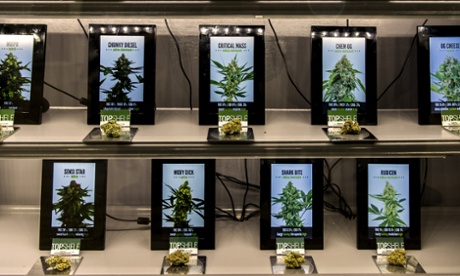
Highly regulated shops sell medicine patients can smoke with names like Jack Frost and Biodiesel; edible versions of cannabis are also available, from the newfangled, like ice-cream, sparkling sodas and chocolate, to old standbys like cookies and brownies. A webcast to go live on Sunday evening on 60MinutesOvertime.com will feature a whole segment on the various kinds of marijuana-infused edible products Kroft found.
The rush, like those for silver or gold so long ago, is attracting investors, or as some call them, "ganjapreneurs." Kristi Kelly came to Colorado to make money on marijuana. "There's not a lot of opportunities in any one lifetime where you can be part of something from such an early stage," she tells Kroft.
The federal government has done little in the state to interfere in the booming trade. And even if it chose to, the sheer number of dispensaries would present a daunting challenge. The Justice Department, however, has warned that financial institutions could be prosecuted for handling money from such businesses. This is a situation ganjapreneurs cannot tolerate much longer as their businesses grow larger.

This past week, a federal appeals court in Washington held a hearing on whether to change marijuana's status under the Controlled Substances Act. Medical marijuana advocates are suing to remove cannabis from the Schedule One list and reclassify it as a drug that could be prescribed by physicians.

Meanwhile, Colorado could become the first state to legalize pot. A referendum is on next month's ballot that if passed, would legalize recreational use of marijuana with regulations.


© 2012 CBS Interactive Inc. All Rights Reserved. 

Archivio blog