On Tuesday, September 9th the Global Commission on Drug Policy released a new, groundbreaking report, Taking Control: Pathways to Drug Policies that Work, at a press conference at MOMA in New York City.
Visualizzazione post con etichetta Drug Policy. Mostra tutti i post
Visualizzazione post con etichetta Drug Policy. Mostra tutti i post
sabato 13 settembre 2014
Report Launch:Taking Control: Pathways to Drug Policies that Work
On Tuesday, September 9th the Global Commission on Drug Policy released a new, groundbreaking report, Taking Control: Pathways to Drug Policies that Work, at a press conference at MOMA in New York City.


sabato 22 dicembre 2012
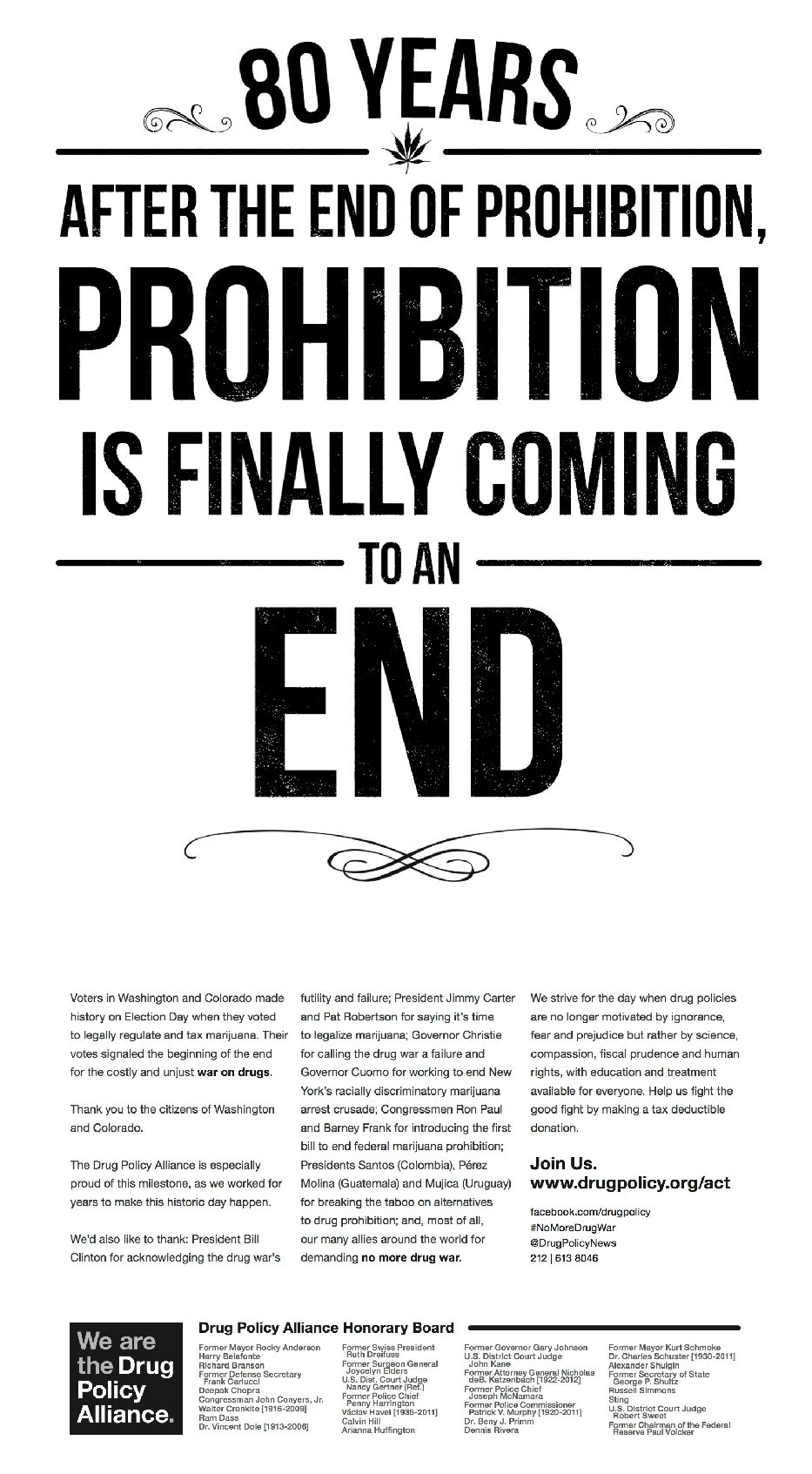
Thank you to the citizens of Washington and Colorado.
The Drug Policy Alliance is especially proud of this milestone, as we worked for years to make this historic day happen.
We’d also like to thank: President Bill Clinton for acknowledging the drug war’s futility and failure; President Jimmy Carter and Pat Robertson for saying it’s time to legalize marijuana; Governor Christie for calling the drug war a failure and Governor Cuomo for working to end New York’s racially discriminatory marijuana arrest crusade; Congressmen Ron Paul and Barney Frank for introducing the first bill to end federal marijuana prohibition; Presidents Santos (Colombia), Pérez Molina (Guatemala) and Mujica (Uruguay) for breaking the taboo on alternatives to drug prohibition; and, most of all, our many allies around the world for demanding no more drug war.
We strive for the day when drug policies are no longer motivated by ignorance, fear and prejudice but rather by science, compassion, fiscal prudence and human rights, with education and treatment available for everyone. Help us fight the good fight by making a tax deductible donation.”
giovedì 20 dicembre 2012
Federal Crackdown on Medical Marijuana: Oakland Fights Back, Mendocino County Still Deciding
December 19, 2012, 3:15 pm
Last week on ABC News' 20/20, Barbara Walters asked President Obama if he thought marijuana should be legalized.
"I wouldn't go that far," Obama said. "But what I think is that at this point, Washington and Colorado, you've seen the voters speak on this issue.
And as it is, the federal goverment has a lot to do when it comes to
criminal prosecutions. It does not make sense from a prioritization
point of view for us to focus on recreational drug users in a state that
has already said under state law that's legal."
 Those comments, however, may come as a surprise to those who follow
the medical marijuana issue in California. In October 2011, the four U.S. attorneys for the state announced
it was going to be no more Mr. Nice Guy when it comes to federal
enforcement of the burgeoning medical marijuana industry. In that press
conference, Melinda Haag, the U.S. attorney for the Northern District of
California, provided a number of reasons for cracking down on medical
marijuana, including environmental harm by growers and the proliferation
of retail stores "motivated not by compassion but by money."
Those comments, however, may come as a surprise to those who follow
the medical marijuana issue in California. In October 2011, the four U.S. attorneys for the state announced
it was going to be no more Mr. Nice Guy when it comes to federal
enforcement of the burgeoning medical marijuana industry. In that press
conference, Melinda Haag, the U.S. attorney for the Northern District of
California, provided a number of reasons for cracking down on medical
marijuana, including environmental harm by growers and the proliferation
of retail stores "motivated not by compassion but by money."
"What we are finding is that people are using the cover of medical marijuana to make extraordinary amounts of money," Haag said. "In short, to engage in drug trafficking."
When it came to taking action against purveyors of pot in the state, the U.S. attorneys were true to their word. In Northern California alone dozens of dispensaries have been shut down, including some high-profile businesses that not only enjoyed solid reputations as responsible industry players, but which were operating with the express approval of local governments.
That hasn't mattered. While passage of Proposition 215 in 1996 legalized medical marijuana in the state, its sale is still a felony under federal law.
Oakland Comes to Defense of Harborside
One successful strategy in shuttering marijuana retail operations has been to threaten landlords of dispensaries with forfeiture of their property.
This is the tack U.S. Attorney Haag took in taking on
Oakland's Harborside, which operates under a city permit. To some, the
action against Harborside represents an expansion of the federal
crackdown, which had previously used proximity to schools as its main
criteria for targeting. But in threatening action against Harborside's
landlord, the U.S. Attorney's office cited the size of the business,
which may be the biggest in the world with over 100,000 patients served.
Steve DeAngelo, Harborside's cofounder and executive director, told Oakland North in October that Harborside earned $22 million in sales in 2011, paying the city $1.2 million in taxes.
"The Justice Department issued a statement that said we'd been
targeted because of an abstract principle that larger dispensaries tend
to result in more people inappropriately receiving cannabis," Harborside owner Steve DeAngelo told us
in July. "I don't think that's a valid principle, but even if it were,
to target an organization like Harborside that has an exemplary record
of legal compliance simply because of a general principle that may or
not apply to other people in the industry is really an egregious abuse
of prosecutorial discretion.
"I think the Justice Dept has grievously overreached; I think the amount of support both from public and elected officials demonstrates that."
And indeed, the city of Oakland has stepped up to support Harborside, becoming the first city to file suit against the federal government in relation to the targeting of marijuana facilities. Oakland says the federal government can’t seize the property that Harborside leases because the federal statue of limitations has run out. The city also claims the federal government misled it into thinking it could license dispensaries without legal consequences.
"We’re concerned that the government, through its action and inaction, caused the city to rely on the fact that we could proceed to dedicate the resources that we did to set up this dispensary system," Oakland City Attorney Barbara Parker told KQED in October.
In the meantime, Harborside has refused to shut down. “We are
open and we have no intention of closing our doors voluntarily,”
DeAngelo said. “We made a commitment to our patients six years ago to
provide them with a safe place to get cannabis medicines and we're going
to do that unless it becomes impossible.”
Harborside's landlords in both Oakland and San Jose, where it also
runs a dispensary subject to forfeiture proceedings, have gone to court
attempting to force an eviction. But an Alameda County judge said on
Nov. 30 that state courts did not have the power to enforce federal law.
As the Oakland Tribune reported, the ruling held that "under state law, Harborside was running a legal business and had not violated its lease."
The case is scheduled to be heard in federal district court by Chief Magistrate Judge Maria-Elena James on Thursday. On the table are motions by Harborside’s landlords asking the court to enjoin the dispensary from selling medical marijuana while the issue of the forfeiture is adjudicated.
Oakland has filed a motion to stay the landlords’ requests.
Mendocino County: 'Model' Program Now Ended, Still Under Attack
From the point of view of medical pot advocates, Mendocino County, a longtime hub of illegal marijuana distribution, has been one of the most forward-looking local governments in terms of bringing order to the vague legalization mandate of Prop 215.
The county’s 9.31 ordinance set up a unique first-in-the-nation permitting program under which marijuana growers were allowed to cultivate up to 99 plants, provided they complied with regulations like restrictions on the locations in which they operated. The program also brought much-needed revenue to the county.
Mendocino County officials like Sheriff Tom Allman and Supervisor John McCowen argued that the program encouraged illegal actors in the marijuana trade to go legit, reducing crime and the need for law enforcement resources to address it.
But last year, the DEA raided Northstone Organics, owned and operated by Matt Cohen, a vocal proponent of legitimizing the medical marijuana trade through regulation. Cohen has been described by Michael Montgomery, who covers drug issues for KQED, as the “poster child” for compliance with Mendocino County’s regulatory regime. He has also been an advocate for using the Mendocino model as the way forward for expanded legalization of medical marijuana.
But
the DEA's action was just the beginning. Earlier this year, Melinda
Haag's office told the county it had to end the program or face possible
litigation. After some debate, supervisors decided to “effectively gut
the program,” says Michael Montgomery. "After that, most people in
Mendocino thought the matter was over, that they had complied with the
federal government."
But in early December news emerged that a grand jury had been convened, and had issued subpoenas
to Sheriff Allman, his captain who oversaw the permitting program, the
financial manager for the sheriff's office, and the county
Auditor-Controller. Montgomery says Mendocino officials have reacted
with "shock and anger and concern” to the order, which calls for the
officials to hand over all records related to the program.
After an extension, the county now has until Jan 8 to comply, and its hired a San Francisco attorney to help represent it. Some involved in the Mendocino marijuana industry have pleaded with the county not to cooperate with the federal government.
"Please don't give this information to the federal government because patients' information and entire coops' information is accessible," said Matt Cohen at a recent supervisors' meeting. "This would not be the right thing to do."
No one really knows what the feds are after -- whether it's criminal prosecutions or something else. But Mendocino County Supervisor Dan Hamburg, a former Democratic congressman, said he thinks the money that the county made from the program is a likely target. The Ukiah Daily Journal recently reported that "proceeds from the popular permitting program ... had mounted to more than $1 million by January of this year.”
"You've probably heard the term smash and grab, when the DEA comes into a dispensary and takes their money, takes their marijuana out the door and that’s the end of that," Hamburg told Michael Montgomery recently. "I sort of see this as a form of that. They weren't satisfied with us shutting down the objectionable part of the program. And now they want to come back for the money that came into the program ... It seems that's the information they want and the only thing I can draw from that is it's some kind of a forfeiture proceeding."
If that’s the case, Sheriff Tom Allman told Montgomery, "We're not going to be able to write them a check, I'll tell you that. They better take payments, because we're broke."
Hamburg, who expressed reservations about the program when it was operational, doesn't want to see the federal government go after county assets. He says, "I just don't see the good sense of Mendocino County having to forfeit money from a program done in good faith and done with really trying to get a hand on regulating this practice in Mendocino County, which by the way has been going on for four decades. So if Melinda Haag and the federal government think 'oh we're going to put marijuana out of business in Mendocino County'...that's just not going to happen. You can't put the toothpaste back in the tube."
Why California?
Colorado and Washington, the two states that have legalized recreational marijuana, are now deciding how to build regulatory systems for growers and distributors, says Michael Montgomery.
"The big question is what are the feds going to do in these states. What they've done in places like Mendocino that have tried to regulate could be a clue."
On the other hand, Montgomery says, Colorado set up a fairly elaborate system to govern medical marijuana from the start, drawing little interference from the federal government.
"So is the message that if you set up tight regulatory system you're going to be okay? I don’t know," he says.
Another difference between California and other states that have legalized medical marijuana is that some Californians have flaunted their federally illegal activities in a very public way. Mendocino County's Matt Cohen, for example, appeared in documentaries about the state's marijuana business on both KQED TV and the PBS program Frontline. And Harborside's Steve DeAngelo was the subject of his own reality TV series on The Discovery Channel -- "Weed Wars."
In a March interview with Michael Montgomery about the reasons for what some at the time considered to be a rather sudden focus federal focus on marijuana, Melinda Haag said, "Marijuana dispensaries are full of cash and they're full of marijuana and everybody knows that. And many of them are very public about their operations. Some of them go on television, most of them have websites, and everybody knows where they are."
DeAngelo, for his part, told us he doesn't regret doing the show.
"Absolutely not. After it aired we had a flood of senior citizens coming in, veterans, people from states where they don’t have access to medical cannabis. We had dozens and dozens of parents of gravely ill children coming to us because of what they saw...and we were able to provide a positive example of cannabis distribution for the world."
"I would say, however, that I think there's a connection between my outspoken views and Harborside being targeted."
For his part, Montgomery said it's important to pay close attention to President Obama's choice of words when it comes to speculating on how the federal government might handle the new world of marijuana legalization in the states.
"The president said it didn't make sense for the federal government to use its resources targeting recreational users in states that have legalized pot. But that's really embracing the status quo. The real question, which the president didn't address, is how the feds will handle the emergence of major cultivation and distribution networks for a drug that is still classified under federal law as a Schedule 1 narcotic. Do the clues for future federal action lie in Colorado or in California?"
Federal Crackdown on Medical Marijuana: Oakland Fights Back, Mendocino County Still Deciding
Last week on ABC News' 20/20, Barbara Walters asked President Obama if he thought marijuana should be legalized.
Marijuana plant buds at a dispensary.
 Those comments, however, may come as a surprise to those who follow
the medical marijuana issue in California. In October 2011, the four U.S. attorneys for the state announced
it was going to be no more Mr. Nice Guy when it comes to federal
enforcement of the burgeoning medical marijuana industry. In that press
conference, Melinda Haag, the U.S. attorney for the Northern District of
California, provided a number of reasons for cracking down on medical
marijuana, including environmental harm by growers and the proliferation
of retail stores "motivated not by compassion but by money."
Those comments, however, may come as a surprise to those who follow
the medical marijuana issue in California. In October 2011, the four U.S. attorneys for the state announced
it was going to be no more Mr. Nice Guy when it comes to federal
enforcement of the burgeoning medical marijuana industry. In that press
conference, Melinda Haag, the U.S. attorney for the Northern District of
California, provided a number of reasons for cracking down on medical
marijuana, including environmental harm by growers and the proliferation
of retail stores "motivated not by compassion but by money.""What we are finding is that people are using the cover of medical marijuana to make extraordinary amounts of money," Haag said. "In short, to engage in drug trafficking."
When it came to taking action against purveyors of pot in the state, the U.S. attorneys were true to their word. In Northern California alone dozens of dispensaries have been shut down, including some high-profile businesses that not only enjoyed solid reputations as responsible industry players, but which were operating with the express approval of local governments.
That hasn't mattered. While passage of Proposition 215 in 1996 legalized medical marijuana in the state, its sale is still a felony under federal law.
Oakland Comes to Defense of Harborside
One successful strategy in shuttering marijuana retail operations has been to threaten landlords of dispensaries with forfeiture of their property.
"I think the Justice Dept has grievously overreached; I think the amount of support both from public and elected officials demonstrates that."
And indeed, the city of Oakland has stepped up to support Harborside, becoming the first city to file suit against the federal government in relation to the targeting of marijuana facilities. Oakland says the federal government can’t seize the property that Harborside leases because the federal statue of limitations has run out. The city also claims the federal government misled it into thinking it could license dispensaries without legal consequences.
"We’re concerned that the government, through its action and inaction, caused the city to rely on the fact that we could proceed to dedicate the resources that we did to set up this dispensary system," Oakland City Attorney Barbara Parker told KQED in October.
The case is scheduled to be heard in federal district court by Chief Magistrate Judge Maria-Elena James on Thursday. On the table are motions by Harborside’s landlords asking the court to enjoin the dispensary from selling medical marijuana while the issue of the forfeiture is adjudicated.
Oakland has filed a motion to stay the landlords’ requests.
Mendocino County: 'Model' Program Now Ended, Still Under Attack
From the point of view of medical pot advocates, Mendocino County, a longtime hub of illegal marijuana distribution, has been one of the most forward-looking local governments in terms of bringing order to the vague legalization mandate of Prop 215.
The county’s 9.31 ordinance set up a unique first-in-the-nation permitting program under which marijuana growers were allowed to cultivate up to 99 plants, provided they complied with regulations like restrictions on the locations in which they operated. The program also brought much-needed revenue to the county.
Mendocino County officials like Sheriff Tom Allman and Supervisor John McCowen argued that the program encouraged illegal actors in the marijuana trade to go legit, reducing crime and the need for law enforcement resources to address it.
But last year, the DEA raided Northstone Organics, owned and operated by Matt Cohen, a vocal proponent of legitimizing the medical marijuana trade through regulation. Cohen has been described by Michael Montgomery, who covers drug issues for KQED, as the “poster child” for compliance with Mendocino County’s regulatory regime. He has also been an advocate for using the Mendocino model as the way forward for expanded legalization of medical marijuana.
After an extension, the county now has until Jan 8 to comply, and its hired a San Francisco attorney to help represent it. Some involved in the Mendocino marijuana industry have pleaded with the county not to cooperate with the federal government.
"Please don't give this information to the federal government because patients' information and entire coops' information is accessible," said Matt Cohen at a recent supervisors' meeting. "This would not be the right thing to do."
No one really knows what the feds are after -- whether it's criminal prosecutions or something else. But Mendocino County Supervisor Dan Hamburg, a former Democratic congressman, said he thinks the money that the county made from the program is a likely target. The Ukiah Daily Journal recently reported that "proceeds from the popular permitting program ... had mounted to more than $1 million by January of this year.”
"You've probably heard the term smash and grab, when the DEA comes into a dispensary and takes their money, takes their marijuana out the door and that’s the end of that," Hamburg told Michael Montgomery recently. "I sort of see this as a form of that. They weren't satisfied with us shutting down the objectionable part of the program. And now they want to come back for the money that came into the program ... It seems that's the information they want and the only thing I can draw from that is it's some kind of a forfeiture proceeding."
If that’s the case, Sheriff Tom Allman told Montgomery, "We're not going to be able to write them a check, I'll tell you that. They better take payments, because we're broke."
Hamburg, who expressed reservations about the program when it was operational, doesn't want to see the federal government go after county assets. He says, "I just don't see the good sense of Mendocino County having to forfeit money from a program done in good faith and done with really trying to get a hand on regulating this practice in Mendocino County, which by the way has been going on for four decades. So if Melinda Haag and the federal government think 'oh we're going to put marijuana out of business in Mendocino County'...that's just not going to happen. You can't put the toothpaste back in the tube."
Why California?
Colorado and Washington, the two states that have legalized recreational marijuana, are now deciding how to build regulatory systems for growers and distributors, says Michael Montgomery.
"The big question is what are the feds going to do in these states. What they've done in places like Mendocino that have tried to regulate could be a clue."
On the other hand, Montgomery says, Colorado set up a fairly elaborate system to govern medical marijuana from the start, drawing little interference from the federal government.
"So is the message that if you set up tight regulatory system you're going to be okay? I don’t know," he says.
Another difference between California and other states that have legalized medical marijuana is that some Californians have flaunted their federally illegal activities in a very public way. Mendocino County's Matt Cohen, for example, appeared in documentaries about the state's marijuana business on both KQED TV and the PBS program Frontline. And Harborside's Steve DeAngelo was the subject of his own reality TV series on The Discovery Channel -- "Weed Wars."
In a March interview with Michael Montgomery about the reasons for what some at the time considered to be a rather sudden focus federal focus on marijuana, Melinda Haag said, "Marijuana dispensaries are full of cash and they're full of marijuana and everybody knows that. And many of them are very public about their operations. Some of them go on television, most of them have websites, and everybody knows where they are."
DeAngelo, for his part, told us he doesn't regret doing the show.
"Absolutely not. After it aired we had a flood of senior citizens coming in, veterans, people from states where they don’t have access to medical cannabis. We had dozens and dozens of parents of gravely ill children coming to us because of what they saw...and we were able to provide a positive example of cannabis distribution for the world."
"I would say, however, that I think there's a connection between my outspoken views and Harborside being targeted."
For his part, Montgomery said it's important to pay close attention to President Obama's choice of words when it comes to speculating on how the federal government might handle the new world of marijuana legalization in the states.
"The president said it didn't make sense for the federal government to use its resources targeting recreational users in states that have legalized pot. But that's really embracing the status quo. The real question, which the president didn't address, is how the feds will handle the emergence of major cultivation and distribution networks for a drug that is still classified under federal law as a Schedule 1 narcotic. Do the clues for future federal action lie in Colorado or in California?"
Federal Crackdown on Medical Marijuana: Oakland Fights Back, Mendocino County Still Deciding
Iscriviti a:
Post (Atom)