cookie

Translate

Visualizzazione post con etichetta Denver Post. Mostra tutti i post

lunedì 29 agosto 2016

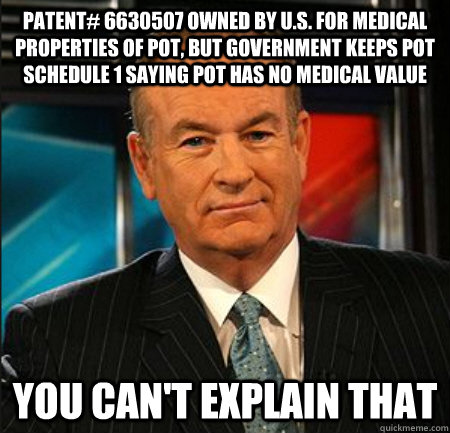
Patent No. 6,630,507: Why the U.S. government holds a patent on cannabis plant compounds


It’s about technology transfer, not legalization


By ALICIA WALLACE | awallace@denverpost.com
PUBLISHED: August 28, 2016 at 12:01 am | UPDATED: August 27, 2016 at 10:03 pm


It may not have quite the same ring to it as a certain seven-digit phone number made famous by a 1980s pop hit, but 6,630,507 has become internet-famous since the U.S. Drug Enforcement Administration opted not to reschedule marijuana, leaving it in the category of drugs with no legitimate medical uses.


Since then, proponents of legalization have responded with a storm of social-media posts highlighting U.S. Patent No. 6,630,507, granted in 2003 to the U.S. Department of Health and Human Services and covering the potential use of non-psychoactive cannabinoids to protect the brain from damage or degeneration caused by certain diseases, such as cirrhosis. They’re telling the DEA to “talk to the hand,” writing “6,630,507” on their palms, hashtagging the number and linking to past articles on the topic.


The intent of the posts is symbolic, said Sam Mendez, an intellectual property and public policy lawyer who serves as the executive director of the University of Washington’s Cannabis Law & Policy Project.

“Naturally, it shows that there is a certain amount of hypocrisy that there is ‘no accepted medical use’ for cannabis according to federal law,” Mendez said. “And yet here you have the very same government owning a patent for, ostensibly, a medical use for marijuana.”


Mendez — like patent lawyers, the research arm of the HHS and the New York biopharmaceutical firm that’s working as an exclusive licensee under the patent — cautions that the existence of Patent No. 6,630,507 doesn’t signal that legalization is on the horizon.


“The government is allowed to file and obtain patents, and that has no bearing on the Controlled Substances Act,” Mendez said.


But it does indicate what could result if cannabis were rescheduled: an explosion of marijuana-related patents, Mendez said.

No. 6,630,507’s inception

The National Institutes of Health employs roughly 6,000 Ph.D.-level scientists, said NIH special adviser for technology transfer Mark Rohrbaugh, who holds doctorates in biochemistry and law. When one of those scientists invents a new technology or makes a new discovery, the NIH evaluates the result and determines whether to file for a patent.


Over the years, the NIH has conducted and funded research involving cannabis — both as a drug of abuse and for its potential therapeutic properties, NIH spokeswoman Renate Myles said.


In the case of No. 6,630,507, the researchers discovered that non-psychoactive compounds in cannabis may have antioxidant properties that could be beneficial in the treatment of certain neurological diseases, she said.


“This patent describes the therapeutic potential for cannabinoid chemical compounds that are structurally similar to THC, but without its psychoactive properties, thereby treating specific conditions without the adverse side effects associated with smoked marijuana,” Myles said in an e-mail.


The patent doesn’t prove the chemical compound is effective in the stated treatment, Rohrbaugh said. The compound would have to be purified, synthesized in a lab setting, subjected to extensive testing in animals and humans, and ultimately require U.S. Food and Drug Administration approval to show that it’s safe and effective for the intended purpose.


The intent behind patenting and licensing NIH discoveries is to keep technology that could potentially benefit the public from sitting idle, he said.


This sometimes requires looping in the private sector, he said. Laws made in the 1980s help entities such as universities and the government to make their discoveries accessible to others who are in a position to further the research and potentially commercialize the developments. The entities behind the discoveries typically receive payments as part of the licensing agreement.


NIH’s Technology Transfer Office advertises patents — including those related to cannabinoids — available for licensing on its website, and officials sometimes conduct outreach as well. The licenses often are packaged with some elements of exclusivity, Rohrbaugh said.

“It’s like a piece of land,” he said. “You wouldn’t build a million-dollar house on a piece of land you wouldn’t have some title to.”


Five years ago, the NIH granted New York-based Kannalife Sciences Inc.an exclusive license for the part of the technology outlined in the patent to develop cannabinoid- and cannabidiol-based drugs for the treatment of hepatic encephalopathy — brain damage that could result from conditions such as cirrhosis. Kannalife also has a non-exclusive license to develop drugs to treat chronic traumatic encephalopathy, a rare and progressive degenerative brain condition likely caused by repeated head trauma, Myles said.


“Other companies may also apply for licenses to use this patented technology to develop drugs to treat other neurological diseases where antioxidant properties of cannabinoid drugs may be beneficial,” she said. “The patent expires on April 21, 2019, after which anyone would be free to develop drugs based on these cannabinoids that, like all drugs, would require FDA approval to demonstrate safety and effectiveness in humans.”


No other companies have licensed portions of the 6,630,507 patent, she said.


Kannalife CEO Dean Petkanas did not disclose the specific terms of the licensing agreement, but he told The Cannabist that the deal includes milestone payments, a percentage of sales as well as royalties in “the six figures” to the government. The patent is valid in several jurisdictions, including the United Kingdom and Australia, he said.


Petkanas said his company “could not have gotten a better ruling” from the DEA.


“We’ve been building our business from the pharmaceutical side from Day One,” said Petkanas, a former executive at the investment firm depicted in the film “The Wolf of Wall Street.” “We want to be on the pharmaceutical side; everything we do has to be by the book.”


Kannalife, recently featured in a football-related Sports Illustrated reportregarding its research into therapies for chronic traumatic encephalopathy, is about to begin raising $15 million in private investments. The money would allow it to start clinical trials related to hepatic encephalopathy as soon as the first quarter of 2018. Petkanas said Kannalife anticipates eventually seeking orphan drug status — a special FDA designation for treating rare conditions. The company also contemplating conducting chronic traumatic encephalopathy-related trials in Europe.


“Does marijuana have medicinal benefit? Well, yeah,” Petkanas said. “But it can’t be targeted and qualified for repetitive use (without the FDA-approved research).”


That one arm of the federal government is poised to make money from cannabis-derived compounds, and another has approved synthetic cannabinoid drugs such as Marinol and Syndros, tells a story different from the one told by the DEA, which lumped together the hundreds of chemical compounds of cannabis as a Schedule I substance, said Gregory F. Wesner, a Seattle-based patent and trademark attorney for Lane Powell PC.


“The interesting thing here is basically the government being two-faced,” Wesner said.


If and when national legalization comes, it’ll trigger a swarm of new patent applications, said the UW Cannabis Law Project’s Mendez.

“That’s massive growth that does not occur every day or every year That’s the kind of growth you’re talking about once in a generation,” he said of the potential sales growth in the industry. “As part of that, you’re going to see many people and many businesses research this far more intensely and file for patents.”


An analysis conducted by Christopher Freerks, a Lane Powell patent administrator, shows that the PTO already has granted at least four dozen cannabis-related utility patents, including No. 6,630,507. The analysis does not include plant patents, which have been tougher to come by for some cultivators.


San Diego patent attorney Dale C. Hunt, an Open Cannabis Project board member who has degrees in botany, genetics and biology, said one would need to develop a completely new strain in order to land a patent.


If marijuana is rescheduled, it’s realistic to believe that the innovation could carry on in the laboratories of NIH scientists, he said. But for now, the federal government’s technology transfer and patenting actions around cannabis do not appear to be widespread.


“(Tech transfer) happens all the time,” Hunt said. “It obviously doesn’t happen all the time in cannabis.”


Patent No. 6,630,507: Why the U.S. government holds a patent on cannabis plant compounds

lunedì 23 febbraio 2015

Pot bank decision appears headed to Fed board

By David Migoya
The Denver Post

The decision of whether a Colorado credit union created just for the marijuana industry can open its doors ultimately could come from the nation's top financial policymakers.

Although the board of governors of the Federal Reserve System in Washington, D.C., typically does not involve itself with local issues handled by the nation's 12 regional reserve banks, a bank solely for marijuana money appears to be a different matter.

For more see: Denverpost.com: Pot bank decision appears headed to Fed board

domenica 9 giugno 2013

Former Microsoft exec's Colorado pot plans questioned

Jamen Shively, CEO of Diego Pellicer and a former Microsoft executive
By Eric Gorski
The Denver Post


Jamen Shively is a former Microsoft executive who wants to see the visage of his hemp-growing great-great- grandfather become the Juan Valdez of weed.
But Shively's plans to create the first national marijuana brand — with a strong presence in Colorado soon — is encountering heavy skepticism about running afoul of state laws and inviting federal scrutiny.
Shively said his Washington state company is close to acquiring rights that will allow him to put its Diego Pellicer brand name on a chain of Colorado medical-marijuana dispensaries. If legal, it would prove a creative way around laws barring out-of-state ownership and restricting investment in Colorado pot businesses.
"We want to be the dominant player in the United States market," Shively said. "Whether in the form of acquisitions or a strategic alliance, we are very interested in exploring Colorado."
Colorado is fertile ground as a state that established elaborate regulations for medical marijuana and, along with Washington state, last year became the first to legalize recreational use for adults.
Some outside investors sense opportunity in side businesses that do not grow or sell marijuana, and thus carry less risk — including a private equity firm run by Yale MBAs that is scouting prospects in Colorado.
Of the entrepreneurs trying to get in on the ground floor, Shively has been among the most public.He laid out his vision at a news conference May 30 in Seattle with a high-profile booster at his side: the former president of Mexico, Vicente Fox.
Fox, an acquaintance of Shively's from business dealings in Mexico, supports marijuana legalization and appeared at Shively's invitation. Fox said he is not involved in the business venture.
The 45-year-old Shively, a former Microsoft corporate strategy manager, is seeking investors in a company named for his great-great-grandfather. According to the company, Pellicer was the world's largest hemp grower in the 1890s, supplying rope from his home base in the Philippines to Spanish forces in the Spanish-American War.
Shively already has a deal with a chain of Washington state dispensaries and is negotiating with interests in other states, he said. The company plans to get involved in medical and recreational pot.
"Yes, we are Big Marijuana," Shively announced.
Some news media accounts have said Shively's company has purchased or is about to purchase Colorado dispensaries, but he said that is not true.
Shively said his company is "very close" to finalizing the acquisition of a "specific set of rights" from a Colorado medical-marijuana dispensary company with multiple locations.
He declined to identify the company or go into detail about the rights, citing a confidentiality agreement. But he was confident enough to predict the Diego Pellicer name would appear on Colorado dispensaries in a month or so.
"To operate in this environment, we've had to get pretty creative in terms of our deal structure and exactly what right this will give us," he said.
Shively said he is hopeful restrictions eventually will be loosened and allow for more direct involvement in the Colorado pot industry.
Others are skeptical.
"I don't know how it will work — someone will carry his brand for payment?" said Meg Collins, director of the Cannabis Business Alliance, a trade group for Colorado medical marijuana interests. "All of us were kind of scratching our heads. Every conversation we've had with the Department of Revenue has been pretty clear they want to make sure it's Colorado money being invested in Colorado businesses."
State officials would need to review the arrangement before weighing in, said Julie Postlethwait, spokeswoman for the Colorado Department of Revenue division that oversees medical and recreational marijuana regulations.
Colorado law says licensed marijuana business owners must be residents of the state for at least two years. Out-of-state interests may loan money to Colorado pot businesses but may not share in profits or have any equity stake.
Mark Kleiman, a professor of public policy at the University of California at Los Angeles, who is part of a team hired by Washington state to help craft its recreational pot rules, questioned whether Shively is most interested in promoting his company's stock.
"Maybe he has good legal advice that he can lend a brand name and not be considered by the federal government to be distributing cannabis," he said. "Boy, I wouldn't want to defend that case. ... Nobody has identified anything about this whole thing that makes sense."
Marijuana remains illegal under federal law, and Shively said federal scrutiny is a concern. But he claimed his company's plans do not run against the Obama administration's approach to marijuana.
Generally, the federal government has made enforcement of marijuana laws a low priority. But large operations continue to be targeted, and it's anyone's guess how federal authorities will respond to recreational industries taking shape in Colorado and Washington.
Other businesses are more quietly looking to invest in Colorado.
Partners in Seattle-based Privateer Holdings keep shared office space in Denver and are working on two acquisitions that should be finalized within 90 days, a spokeswoman said, declining to elaborate.
The private equity firm started by partners with Yale MBAs is focused on businesses that do not produce or sell marijuana and already has purchased Leafly, a sort of Yelp for dispensaries and cannabis strains.
Joe Megyesy, a lobbyist on marijuana issues, said out-of-state interest in Colorado can be a double-edged sword — potentially giving the industry legitimacy while putting it at risk of federal attention.
"Maybe," he said, "it could push the federal government into changing their tune and saying, 'Hey, maybe we should stop wasting money trying to make this substance illegal and instead generate tax revenue not just for enforcement but other government services.' "
Eric Gorski: 303-954-1971, egorski@denverpost.com or twitter.com/egorski
The Associated Press contributed to this report.


Read more: Former Microsoft exec's Colorado pot plans questioned - The Denver Post

Follow us:@Denverpost on Twitter|Denverpost on Facebook

lunedì 18 marzo 2013

Still waiting for answers on pot


AG Eric Holder needs to fully explain the federal government's intentions regarding Colorado and Washington state's pot laws.
Posted:   03/16/2013 12:01:00 AM MDT

By The Denver Post Editorial Board

U.S. Attorney General Eric Holder. (Evan Vucci, The Associated Press)
It turns out that U.S. Attorney General Eric Holder hasn't been quite as mysterious about the future of recreational marijuana in Colorado and Washington state as his empty public pronouncements would suggest.
Behind the scenes with state officials, he's apparently been somewhat more forthright. Indeed, Gov. John Hickenlooper's top lawyer, Jack Finlaw, said this week that the federal government's future behavior — toward pot cultivation centers and retail outlets, for example — will be determined by the sort of regulatory framework that state lawmakers put in place.
As The Denver Post's John Ingold explained, "The state must show it can keep marijuana within its borders and away from children and also prove that its regulations are comprehensive enough and well-funded enough to work."
If they meet that standard, Finlaw added, "then [federal officials] will take the same stance on adult recreational use of marijuana as they've taken on medical marijuana."
As advocates of the federal government allowing Colorado and Washington to proceed with their important experiment in regulating marijuana, we consider this news encouraging. But it's also less than fully satisfying, for at least two reasons.
First of all, what does it mean precisely to adopt comprehensive regulations? The work from the governor's Amendment 64 Implementation Task Force, which went to the legislature this week, extends for 165 pages and involves 58 recommendations. By any reasonable standard, that's fairly comprehensive. But are those recommendations enough?
The proposals include everything from mandates for child-resistant packaging and prohibitions on advertising that children are likely to see to possibly limiting the amount of marijuana or marijuana-infused products that can be purchased by out-of-state customers — perhaps to one-eighth to one-quarter ounce of marijuana for non-residents.
But of course Colorado probably can't (and frankly shouldn't) prevent out-of-state residents from buying marijuana altogether, let alone seal state borders sufficiently to keep all home-grown pot here.
So how tight will the regulations have to be to trigger federal tolerance of Amendment 64?
The only person who can answer that question is Holder himself. More than four months after voters approved Amendment 64, it's time Holder stepped up and clearly explained, on the record, the Justice Department's intentions.


Still waiting for answers on pot - The Denver Post

domenica 30 dicembre 2012

Legalized marijuana set to become a big Colorado industry

By Steve Raabe
The Denver Post


Marijuana is poised to make a big splash in Colorado business after the passage of Amendment 64, allowing its legal sale and consumption.
A series of events in 2013 will determine just how big the industry may become.
Before retail stores open, state officials will apply licensing standards and excise-tax rates. Local governments also will decide whether they will impose sales taxes or prohibit retail sales in their jurisdictions.
The industry's financial impact could be significant, based on early projections.
In a fiscal-impact study, the Colorado Center on Law & Policy estimates that legal marijuana sales initially could be as much as $270 million a year. Those sales would produce state and local taxes of $47 million a year, plus savings of $12 million a year in law enforcement costs.
Marijuana tax revenue dedicated to school construction would create an estimated 372 new jobs, according to the study.
Business investment could be slowed by concerns about how, or if, the federal government will enforce the federal prohibition on marijuana.
"That raises potentially serious legal and ethical issues," said Troy Eid, a narcotics-law expert and partner with Greenberg Traurig LLP. "Until Congress acts, business leaders need to be very cautious about investing in Colorado's recreational-marijuana industry."
Employers also will need to deal with the complex legal issue of how to treat workers who violate company policies by smoking legal marijuana while off duty.


Read more: Legalized marijuana set to become a big Colorado industry - The Denver Post

Archivio blog