Legal marijuana is already a global industry and the U.S. is behind the curve

BY WILL YAKOWICZ
Staff writer, Inc.@WillYakowicz
When you think of the legal marijuana industry, you think of Colorado and California. But marijuana is not uniquely American, nor is the legalization movement.
Medical and recreational marijuana is a multi-billion dollar global industry, with various programs either ready to be implemented or already up and running in countries like Canada, Australia, Germany, Italy, and the Czech Republic. Despite global drug policy, marijuana is grown, distributed and used all over the world. While Colorado and California are looked at as models of the modern marijuana economy, the U.S. lags behind other countries like Canada, which already has a fully-functional nationwide medical program and will launch its nationwide recreational program in the next year.
Brendan Kennedy, the cofounder of Privateer Holdings, which owns various marijuana companies like Marley Natural and Canadian pharmaceutical-grade cannabis producer Tilray, says his companies are expanding abroad while the U.S. Drug Enforcement Agency and the Food and Drug Administration debate whether or not to treat the plant as a medicine or keep it in the same category as heroin.
"People think cannabis legalization is a U.S. phenomenon or even a western U.S. paradigm shift, but this is taking place around the world," says Kennedy. "It's a misconception to think this is a Californian thing, or a Colorado thing. It's much larger than that. We look at marijuana from a global perspective."
Kennedy has been to Spain, Portugal, Germany, the Czech Republic, and Italy in the last six months to explore marijuana business opportunities. Currently in the U.K., he will go back to Privateer's headquarters in Seattle, then visit Tilray's 60,000-square foot facilities in British Columbia, Canada, then to Australia, where Tilray has an import license to send marijuana for a clinical trial with a chemotherapy-induced nausea and vomiting study with the University of Sydney, the government of New South Wales and the country's largest cancer hospital.
"These places are already far ahead of the U.S. in terms of implementing and regulating this product as a medicine," says Kennedy. "We spend time in places like these in hopes to build cultivation facilities or import our medical cannabis and medical cannabis products while the DEA and FDA are debating the potential rescheduling."
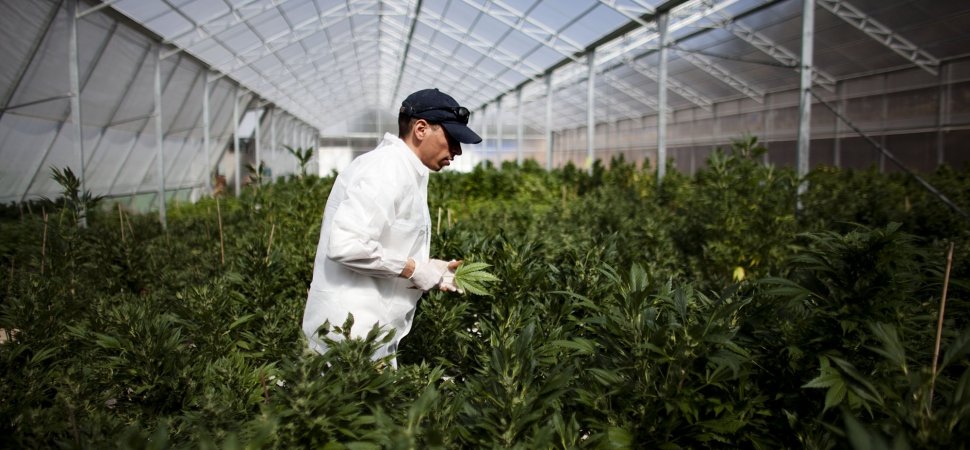 |
| Marijuana is being produced around the world, from Israel to Australia. Above, the growing facility of the Tikun Olam in Safed, Israel, with Israel's Health Ministry, distributes cannabis for medicinal purposes to over 1800 people. (Photo by Uriel Sinai/Getty Images) CREDIT: Getty Images |
As the U.S.-based industry awaits that ruling, companies are looking in other countries to hedge their bets on a global, import-export industry. Kennedy says that as marijuana reform spreads across the world, a global economy is forming and marijuana production will start to blossom where other commodities are currently grown, such as coffee, fruit, cotton, tobacco and medicinal opium poppies.
"For us, it's more about environmental sustainability and ultimately, it's a crop that is the basis for this product and it should be grown in an environment where sunshine is plentiful," says Kennedy.
Tilray is not the only company that has an import-export license to send marijuana to other countries. U.K.-based GW Pharmaceuticals, which is extracting CBD from the cannabis plant to make anti-seizure medication, already has an import-export licenses for marijuana. O.penVape, which is a vaporizer company based in Denver, recently announced a licensing agreement with a Jamaica-based company to grow pot for its vaporizers.
As marijuana slowly emerges from prohibition, it will be easier for companies to legally grow in other countries where there are more ideal climates and water tables that will help lower prices and the indoor grow methods created to escape the DEA's helicopters will become history, Kennedy says.
"If I could short the indoor grow market in Denver, I would," says Kennedy. "You have to look at other models of tightly controlled agricultural products used for medical purposes, like poppies, which are grown in Australia, Spain and other climates that are beneficial for low-cost production. The bulk of marijuana produced around the world will be grown outside in greenhouses or fields."
As marijuana grows head to cheaper pastures outside in states and counties with ideal climates, like California, Texas, Florida, Mexico, Australia, Israel, and South East Asia, each region will have its own properties.
Just like the wine industry, marijuana from specific regions will be defined by its terroir, Kennedy says. Marijuana's terroir could include pot grown in Humboldt, the Emerald Triangle, pot grown near the Sea of Galilee, weed from the Golden Triangle of South East Asia or cannabis grown under the shade of olive trees in Spain, Kennedy suggests.
"I don't think Denver warehouse terroir will be that appealing or competitive," Kennedy says.
Aeron Sullivan, the co-founder of Tradiv, an online wholesale marketplace for legal pot businesses to buy and sell marijuana, says there is no doubt pot production will be outsourced to other regions of the world and the southern states in the U.S.
"Once you can import and export marijuana easily, you will see facilities in places where you can produce as efficiently as possible," says Sullivan, who was recently named on Inc.'s 30 Under 30 list. "Right now in Humboldt, cost per gram is at $1. Why not set up greenhouses in Cambodia with its renewable water tables and grow for ten cents a gram? You can fly over a ton of marijuana for a fairly inexpensive amount."
Sullivan says the U.S. is not the only country moving fast to favorable drug reformation. Pretty soon, he says, the global industry will be up and running and major corporations will have energy efficient grows outside, producing metric ton after metric ton of high-grade marijuana at a low cost production.
"It's a commodity, it's going to grow where ever the commodity grows," says Sullivan. "Oranges grow in Florida, avocados grow in Mexico. Sativa originated in India and commodities grow where they like to grow."


