cookie

Translate

Visualizzazione post con etichetta IRS. Mostra tutti i post

lunedì 2 novembre 2015

Philanthropy in marijuana industry finding larger acceptance

Nonprofits are developing relationships with Colorado cannabis businesses despite lingering worries about federal legality; however, charitable donations aren't welcome by all

By Ivan Moreno, Associated Press

One marijuana business hosts an annual golf tournament in Denver to raise money for multiple sclerosis research. Another Colorado pot company donates to a gay-rights advocacy group and is a sponsor of an AIDS walk.

As marijuana legalization matures, businesses are becoming more ingrained in their communities by donating cash and time to charities — a sign that the stigma of selling a drug that remains illegal under federal law may be fading.

“It’s not all about making money and about profiting,” said Ean Seeb, co-owner of Denver Relief, a dispensary whose monetary and volunteering donations include Ekar Farm and Garden, which grows vegetables for food banks.

It’s unknown how much money marijuana businesses have donated to nonprofits nationally and in Colorado.

“It is a brand new public conversation,” said Tom Downey, a regulatory attorney who specializes in marijuana.

He is a director at the firm Ireland Stapleton, which hosted a meeting in July at the state Capitol regarding donations with about 150 people from charitable organizations, lawyers and pot companies.

The Department of Justice, which has been watching the growing legal pot industries, declined to comment. The IRS declined to comment, except to say that marijuana businesses can’t write off donations on tax filings.

Colorado residents, for example, gave $3.4 billion to charities in 2012, the most recent data available from the IRS, according to the Colorado Association of Funders, a group that represents foundations.

Colorado foundations themselves donated about $800 million to charities in 2013.

The state has nearly 30,000 nonprofits, some of them tiny organizations, all competing for funds, said Joanne Kelley, executive director of the Colorado Association of Funders.

Enter the highly profitable legal marijuana industry, which was worth $2.7 billion in 2014, according to industry investment and research firm The ArcView Group.

But the industry’s profitability, and the charities’ need for contributions, is only one reason nonprofits and pot businesses have developed relationships.

Many in the marijuana industry have been big believers of the drug’s medical value and that has carried over to philanthropy, while the charities themselves sometimes serve populations that use the drug for ailments.
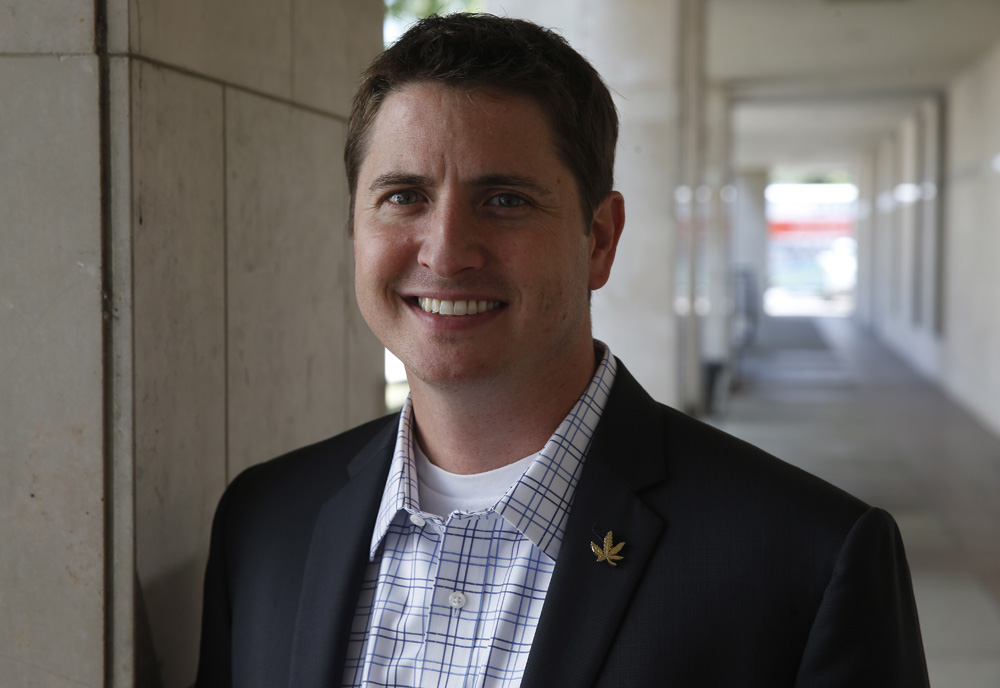

Ryan Cook, general manager of Colorado marijuana
retailer The Clinic says his company supports the National
Multiple Sclerosis Society and has contributed nearly
$291,000 since 2009 through various fundraising efforts.
(Brennan Linsley, The Associated Press)
Matt Huron, founder and CEO of Good Chemistry in Colorado, traces his company’s philanthropy to his time managing a marijuana cooperative that grew pot for people who used it medically in San Francisco.

His father and his partner, who were both HIV positive, used the drug medically. His father died in 2009.

Huron said when it came to giving, he wanted “to keep that spirit alive” when he started his business in Colorado. But he found that some nonprofits were unwilling to accept donations from his company.

While reluctance is fading, he said, a stigma remains.

“We’re still breaking federal law,” he added.

Huron’s company donates to One Colorado, a gay rights advocacy group, but he declined to say how much.

Dave Montez, executive director of One Colorado, said his organization’s standard for accepting donations comes down to whether the contributor is accepting of the gay community.

“Good Chemistry exemplifies a local business who is committed to improving the lives of lesbian, gay, bisexual, and transgender Coloradans by treating their employees fairly as well as giving back to the community,” he said in a statement.

Another marijuana business, The Clinic, hosts an annual golf tournament to raise money for the Colorado and Wyoming chapters of the National Multiple Sclerosis Society.

The Clinic’s general manager, Ryan Cook, said employees also participate in an annual MS walk to raise money and have contributed nearly $291,000 since 2009 from that event and the golf tournament.

Kaylin Daniels, donor relations officer at the National Multiple Sclerosis Society, noted that medical marijuana use is acceptable among its constituency. And she said states’ approval of medical and particularly recreational pot in Colorado has helped develop a connection with The Clinic.

Just last year, Daniels said, The Clinic “became the top corporate team for Walk MS for Colorado and Wyoming.”

Still, some nonprofits are wary of marijuana donations. The Children’s Hospital Colorado Foundation has a policy of not accepting such donations, said spokeswoman Elizabeth Whitehead, because the drug is still illegal federally.

Connie Zimmerman, founder of Colorado Homeless Families, which helps with transitional housing, has not been offered help from marijuana businesses but said she wouldn’t accept it because she considers the drug detrimental to her clients.

“We don’t feel right about accepting donations from the profits and proceeds of the marijuana business that can devalue or diminish the quality of the family and lifestyle relationships of individuals,” Zimmerman said.


Philanthropy in marijuana industry finding larger acceptance

martedì 20 novembre 2012

US marijuana legalisation fuels Mexico drugs war debate

Will Mexico's drug cartels see a drop in profits as a result of changes in the US?

Earlier this month, two US states voted to legalise, regulate and tax marijuana. The BBC's Will Grant in Mexico City looks at what this shift in stance could mean for Mexico and its fight against the drug gangs.
On the day voters in Washington state chose to re-elect President Barack Obama, they also chose to legalise the recreational use of marijuana. Over the Rockies in Colorado, it was a similar story.
"What happened in Colorado and Washington was truly revolutionary," says Beau Kilmer, the co-director of the Rand Drug Policy Research Centre in California. "No modern country has ever removed the prohibition on the production and distribution of marijuana for non-medical purposes."
When the measure comes into effect in Colorado in early December, it will be legal to possess 1oz (28g) of marijuana if you are over 21; it will be legal to grow up to six marijuana plants in your house; and it will be legal to give away up to 1oz.
There are still complex questions about creating a regulatory framework for the production and distribution of the drug, which may take at least another year.
Needless to say, such a move puts the two states on a legal collision course with the federal government and its drug enforcement policies. But Dr Kilmer believes it is a mistake to view the Obama administration as a single entity in this regard.
"At this point no-one knows how the federal government is going to respond to these two states. But it's important that we don't think of it as a homogenous actor."

The Drug Enforcement Administration (DEA), the US Attorney-General's office and the Internal Revenue Service (IRS) all have a degree of jurisdiction, and discretion, over these issues, Dr Kilmer points out.
Use of force Meanwhile, thousands of kilometres away, in a "smoke shop" in Mexico City, the news of Colorado and Washington's decision has been warmly welcomed. Surrounded by glass cabinets full of expensive-looking vaporiser, the proprietor tells me that many of his customers are hoping for a similar law in Mexico.
"People don't want to contribute to the drug cartels' profits any more and I've sold a lot of copies of this recently," he says, holding up a book called The Ecological Cultivation of Cannabis.

The man in Mexico currently leading the charge to change the law is left-wing politician Fernando Belauzaran. He has introduced a bill in Congress along similar lines to the one in Colorado, which would bring marijuana under the same regulation as alcohol.
"What has happened in the US has moved things forward, because this debate is crucial," Mr Belauzaran told the BBC on the day he formally presented the proposal.
"We need to ask if it makes sense to carry on with this full-frontal military campaign which has generated so much destruction and death in our country in order to impede the entrance into the United States of a substance which is now permitted and regulated."
Mr Belauzaran does not necessarily expect his measure to pass in this legislative session. But what is important, he says, is the new discourse on the issue.

In some parts of the US and Mexican media, the decision in Washington state and Colorado has been called a "game-changer" in the bilateral relationship between Mexico and the United States on the war on drugs.
Both the outgoing administration and the incoming one in Mexico have indicated that they expect things to develop with respect to marijuana during President Obama's second term.
Hosting several central American leaders recently, Mexican President Felipe Calderon said the decision in the US was a "change in paradigm" on drug consumption. He called for the United Nations and the Organisation of American States to help clarify the situation.
The new government went even further.
"Obviously, we can't handle a product that is illegal in Mexico, trying to stop its transfer to the United States, when in the United States - at least in part of the United States - it now has a different status," Luis Videgaray, President-elect Enrique Pena Nieto's top adviser, told journalists.
But it is not just in Mexico that the debate on marijuana is shifting. Uruguay too, under left-wing President Jose Mujica, is moving to put the state in charge of regulating the cultivation and consumption of legal cannabis.
Continent-wide, there are obviously many discussions still to be had.
Advocates and opponents disagree about the extent to which legalisation of marijuana would hurt the drug cartels' profits - some quoting figures in the billions, others in the mere tens of millions. And there is still a long way to go before President Obama formulates a coherent response to the voters' decision in the two states.
But amid the smoke and mirrors, one thing seems clear: when it comes to marijuana in the Americas, the seeds of change have been sown.

US marijuana legalisation fuels Mexico drugs war debate

Archivio blog